
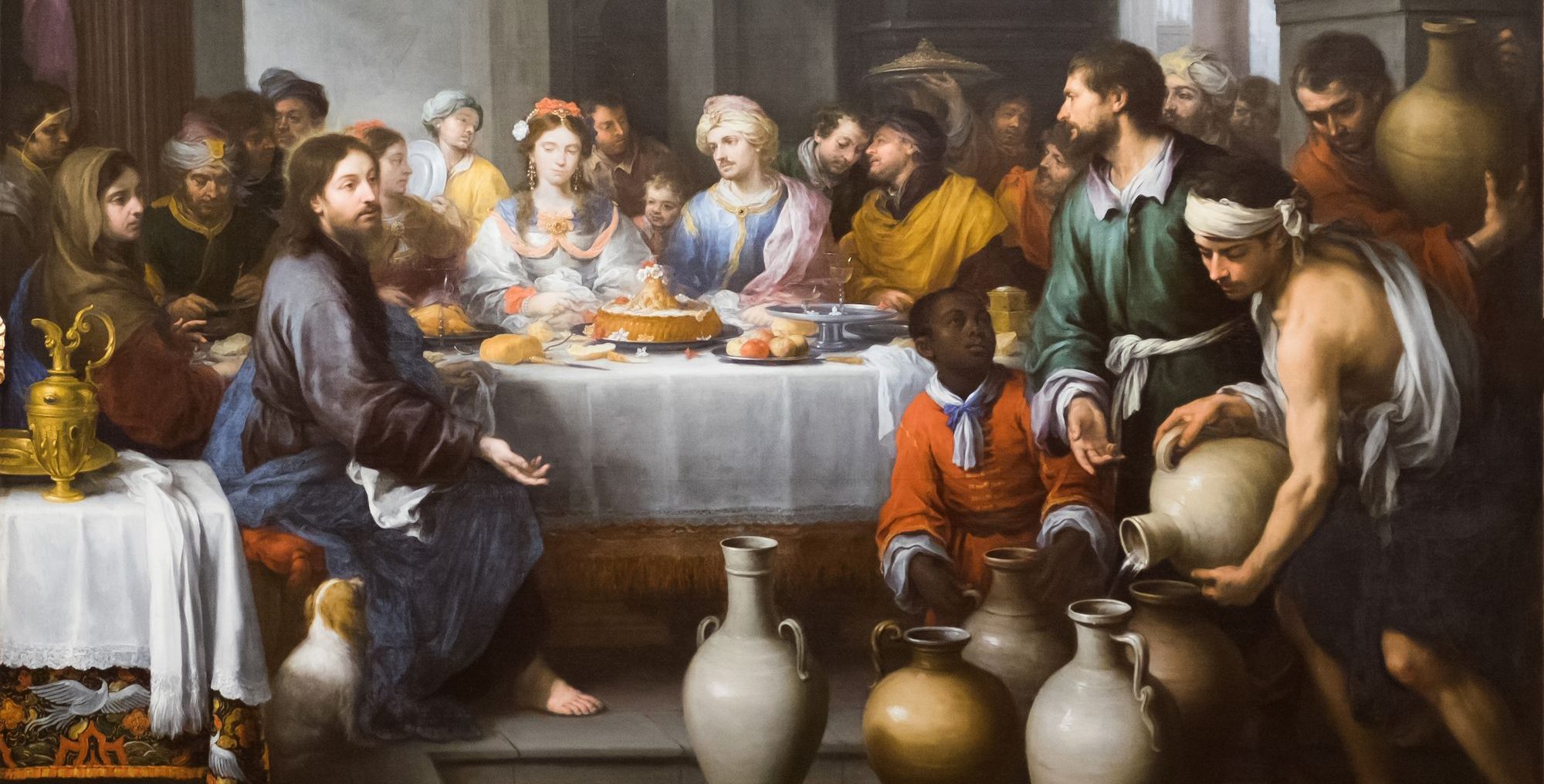
Jesus blesses the newly-wed couple at Cana.
The Marriage Feast at Cana (c. 1672) by Bartolomé Esteban Murillo
The Lord’s teaching on marriage in this Sunday’s Gospel is as counter-cultural today as it was in His own day. In first-century Judaism, marriage was not believed to be indissoluble. Divorce was permitted under the Mosaic law in certain circumstances. Similarly, our own society now thinks of marriage as a breakable contract.
Jesus affirms several points about marriage. First, Jesus teaches that marriage is not just a human institution. Although marriages are initiated by human couples, marriages are formed with the assistance of God. As Archbishop Fulton Sheen said, “It takes three to get married.” Marriage is not an invention of humanity, but a social structure given to humanity by God from the beginning for our good. As a result, governments and societies may regulate marriage for the good of their citizens, but they have no right to redefine what marriage is. God is the author of marriage.
Second, Jesus teaches that marriage is reserved to one man and one woman: “But from the beginning of creation God made them male and female. This is why a man must leave father and mother, and the two become one body.”
Third, Jesus teaches that a validly-formed marriage is indissoluble: “What God has united, man must not divide.” Once a marriage is validly formed, it can only be broken by death. As a consequence, Jesus teaches that “the man who divorces his wife and marries another is guilty of adultery. And if a woman divorces her husband and marries another she is guilty of adultery too.”
These teachings of Jesus are the teachings of the Catholic Church. For some, they can be hard to receive. We all (including me) have people in our lives who are divorced. Some of them may be ‘remarried’. Perhaps you are divorced yourself. Jesus understands that marriages can be hard and that some become unworkable. Jesus is not saying that people need to stay in dangerous or detrimental situations, nor does Jesus want us to be ashamed of our circumstances.
Divorce is a civil reality in Australia. It is important to clarify that it is permissible for Catholics to obtain a civil divorce, but the couple must remember that their marriage remains valid in God’s eyes and they should strive to live accordingly (i.e. they should not enter a relationship after separating). This means that civil divorce is not, in itself, an obstacle to following the Lord. Moreover, couples who have been divorced may apply to have their marriage assessed by the Church for annulment. An annulment is not ‘Catholic divorce’. Rather, annulment is a declaration by the Church that the marriage was never validly formed to begin with. If the declaration of nullity (annulment) is granted, the applicants are then free to enter a new marriage.
Why does Jesus insist on such challenging teachings? As Saint Paul explains in his letter to the Ephesians, marriage is a visible sign of the relationship that God desires with humanity. God, the divine bridegroom, desires an eternal (indissoluble) union of love with humanity, His bride. Marriage is instituted by God as a sign and help to our salvation. The ultimate purpose of marriage is to be a place where we can merit salvation as disciples of the Lord by practicing love of God and neighbour in accord with God’s law. If the Lord’s teaching is challenging for your personal circumstances and you would like guidance or clarification, do not hesitate to reach out to me.