
Homily for Good Friday
3.00pm Friday 18th April 2025
St Anthony of Padua Church, Lara

The Shroud of Turin showing the front image of the body on the left and the back image of the body on the right. The large triangular patches are burn-marks caused during a fire in the 1600s.
The Shroud of Turin is a fourteen-foot linen burial cloth that bears the front and back image of a crucified man. Tradition confidently identifies the man as Jesus.
In the 1980’s, the Shroud was incorrectly dated to the middle ages. The dating was incorrect because the scientists took a sample from the edge of the cloth. Later studies have revealed that the a new edging had been sewn onto the Shroud in the middle ages, presumably because the edges of the original cloth were fraying. More recently, scientists have extracted pollen samples from the Shroud, which were identified as originating from the region of Israel and dated to the first century.
The image on the Shroud is not produced by paint or dye or any other human product. The best current scientific explanation for the origin of the image is that it was caused by an extremely brief and intense explosion of light from within the corpse. This light-produced image is accompanied by numerous blood stains.
Pope John Paul II described the Shroud of Turin as a “mirror of the Gospel”. It gives us a window into Jesus’ sufferings.
The Shroud reveals five types of physical suffering experienced by Jesus. Be prepared, they are confronting.
The first physical suffering the Shroud reveals is the scourging. Scientists have identified numerous scourge marks on both the front image and the back image of the Shroud. They have counted 240 scourge marks on the back of the man and 120 scourge marks on his front: 360 scourge marks in total. The ancient Roman scourge, or flagellum, consisted of three leather straps with a little metal dumbbell on the end. This means that Jesus was scourged a total of at least 120 times, each instance imposing three scourge marks. The man of the Shroud bears scourge marks from his collar bone to his ankles, both on his front and on his back.
The second physical suffering the Shroud reveals is the Crown of Thorns. We tend to think of the Crown of Thorns as a ring-shaped crown. The man of the Shroud, however, bears 30-50 thorn-like puncture wounds all over his head. The crown Jesus wore was more of a helmet, rather than a ring. Scholars have suggested this shape was devised to replicate the shape of the Jewish’ High Priest’s crown. The thorn-plant that was most likely used for the crown has thorns around an inch long. The Gospels tell us the Romans beat the crown of thorns onto Jesus’ head. This makes sense if the crown is shaped like a helmet.
The third physical suffering the Shroud reveals are the nail wounds in the hands and the feet. The nails the Romans used were nine inches long. Commonly, Jesus is depicted with nail wounds in the palms of his hands. The Shroud, however, shows that the nails passed through the intersection of the hand and the wrist. The Romans chose this location for the nails for two reasons. First, there are enough bones in the intersection of the wrist and the hand to support the weight of a body as it hangs on the cross. Second, this is the part of the wrist through which the median nerve passes. The nail would commonly sever the median nerve. The pain caused by this injury alone was given the name ex-cruciatus – literally meaning from the crucis, the cross – from which we derive the word excruciating.
The fourth physical suffering the Shroud reveals is the cause of Jesus’ death: asphyxiation. The Shroud shows two streams of blood flowing from the nail wounds in the wrist, each stream flowing at a slightly different angle. While a crucified person hung from the cross, the angle of the arms made it impossible to exhale. In order to breath, therefore, the crucified person had to lift themselves up. The two streams of blood from the nail wounds reflect the fact that Jesus had to lift himself up whenever he needed to breath. As Jesus tired, he no longer had the strength to lift himself up. In their accounts of the Passion, Matthew and Mark report that Jesus uttered one final cry from the Cross. Gathering his last ounce of strength, he lifted himself up and cried: “Father, into Your hands I commit my spirit.” Then, the Gospel writers tell us, “He breathed His last.”
The fifth physical suffering the Shroud reveals is the wound from the centurion’s spear. The man of the Shroud bears a lance-like wound on his heart side. The angle of the wound and evidence of a stream of blood shows that the lance reached the heart. The blood would have been accompanied by a water-like substance, because the cavity around the heart fills with fluid when the heart and lungs are under severe stress. The spear wound is a compelling proof that the Shroud is the burial cloth of Jesus because it was not a normal part of the crucifixion ritual. John tells us that “the soldiers came and broke the legs of the first, and of the other who had been crucified with him; but when they came to Jesus and saw that he was already dead, they did not break his legs. But one of the soldiers pierced his side with a spear, and at once there came out blood and water.”
If the Shroud is a window onto Jesus’ sufferings, then it is also a window into the love of His Sacred Heart. Jesus came to save us from sin. Sin is the withholding of love from our Heavenly Father. By withholding love from our Father, we lose access to the life of our Father. As a consequence of the first sin and our personal sin, the human race is subject to everlasting death.
Although we withheld love from our Father, our Father continued to love us. He did not abandon us to our self-imposed fate. He sent His Son to save us. To save us, Jesus needed to give the Father a love that compensated for the love that we withhold through sin.
Jesus did not need to suffer and die to save us. All he needed to do to save us was to perform one single act of human love for our Father. Since Jesus is God and man, utterly sinless, his love is of such a quality that one expression of His love would have been enough to compensate for all the love that we have and will ever withhold from our Father.
No, Jesus did not need to suffer and die to express His love for his Father; Jesus suffered and died to express His love for you. Jesus did not need to suffer and die to convince the Father that the Father is loved; Jesus chose to suffer and die to convince you that you are loved. In God’s eyes, the simplest acts can be the most loving, when done with the right intention. But for us, simple acts of love are rarely convincing: we want grand gestures. And the grandest gesture of love that anyone can and will do for you is the suffering and death of Jesus.
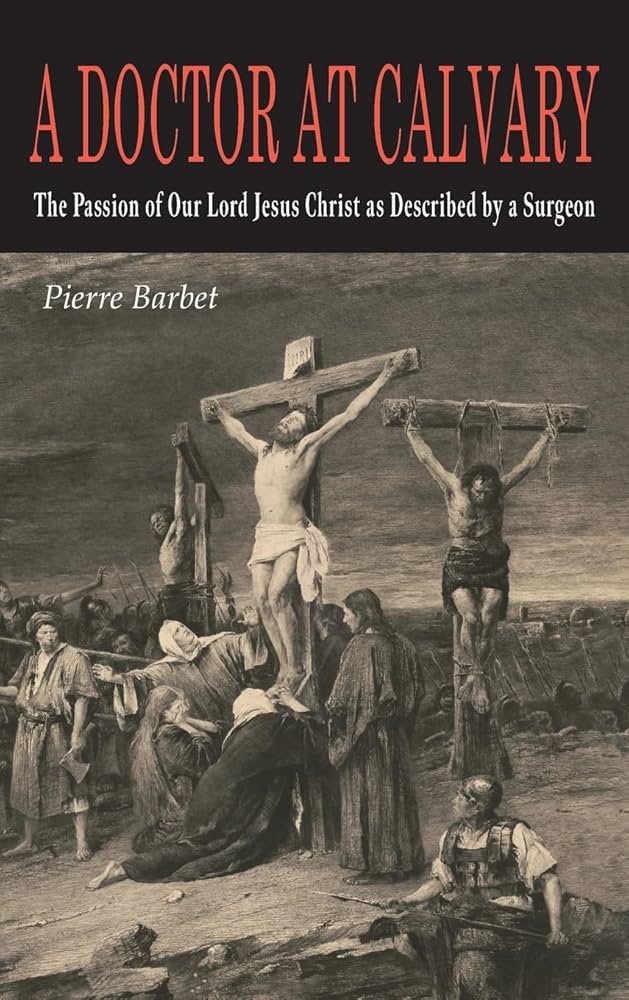
For more information on the sufferings of Jesus as witnessed by the Shroud, read A Doctor at Calvary by Pierre Barbet. You can also listen to this episode of Pints with Aquinas: