
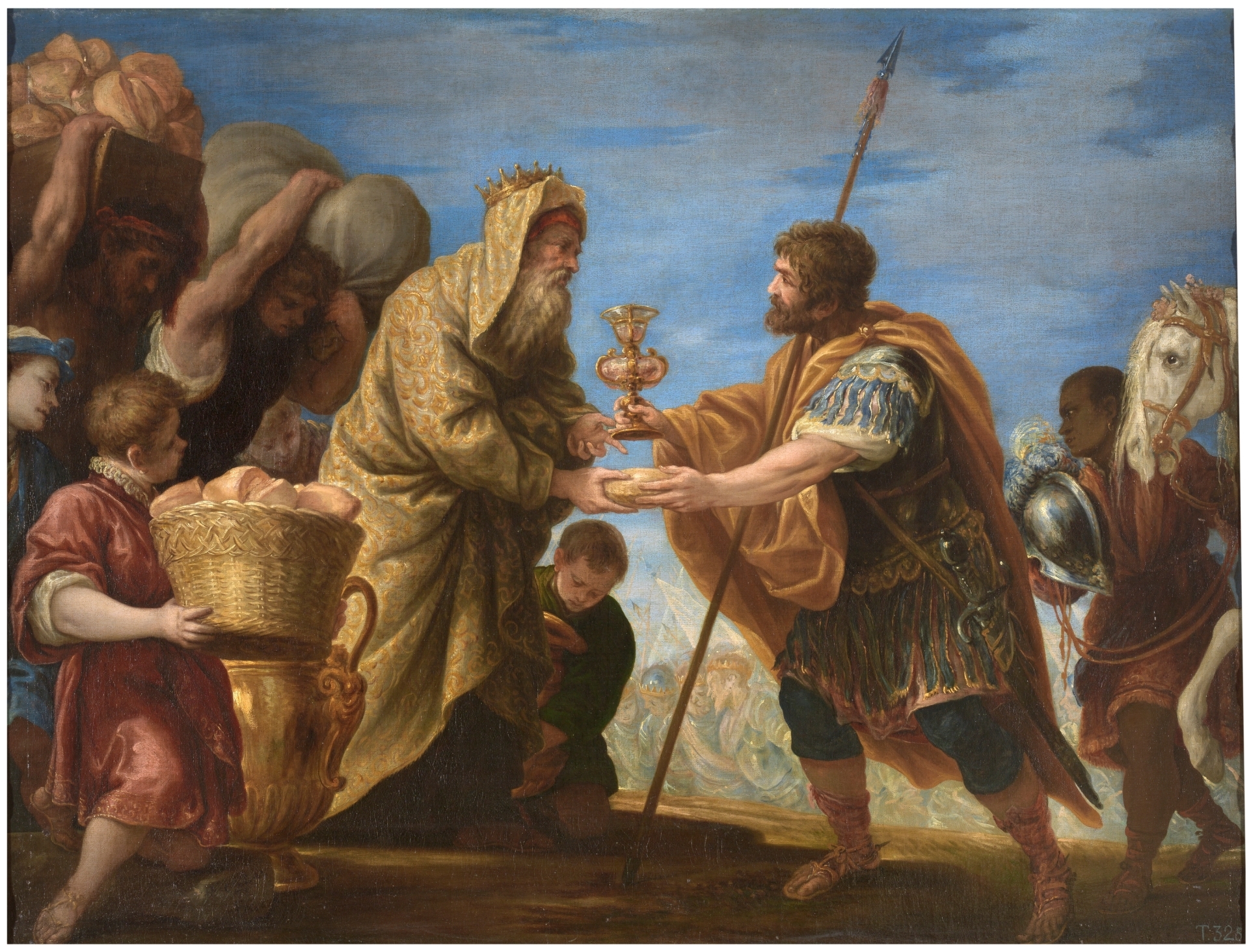
The Meeting of Abraham and Melchizedek (c. 1668), Juan Antonio de Frias y Escalante
Melchizedek is one of the most mysterious figures of the Old Testament. Unlike other patriarchs, we are told neither of his genealogy nor his death. To understand the significance of Melchizedek, we need to review the events that preceded his encounter with Abram.
Lot’s story is our story
Abram was born in modern day Iraq, in the ancient city of Ur. He was a farmer with large herds of cattle and flocks of sheep. Abram did not know the God of his ancestors Adam, Abel and Noah. Nevertheless, God revealed Himself to Abram, inviting him to move his family “to the land that I will show you” (Gen 12:2). Abram gathered his herds and his family, including his brother’s son (his nephew) Lot, and journeyed west towards Lebanon, then south into modern-day Israel.
When Abram and Lot arrived in the land God had promised them, they realised they would need to part company to keep their herds alive. As Genesis reports: “the land could not support both of them dwelling together” (Gen 13:6). Abram gave Lot the first choice of the land. Lot chose to move to the Jordan valley, south of the Dead Sea, because it was fertile and well-watered.
The trade-off was that this fertile land was in the neighbourhood of Sodom and Gomorrah. The citizens of Sodom were notorious sinners: biblical tradition pinpoints Sodom as the origin of sodomy. The point is that Lot’s priorities were all wrong. Instead of choosing land that would help him love God, Lot chose land that would make him materially wealthy, but that also put him close to serious evil. Abram’s priorities were different. He accepted the less productive land because his first concern was serving God. When Abram arrived in his portion of the land, for example, Abram’s first act was to offer sacrifice to God. Lot does nothing of the sort. Abram, the man of God, trusts God and is primarily concerned with serving God. Lot, the man of the world, trusts himself and is primarily concerned with worldly comfort and success.
Things do not work out well for Lot. Several kings from the north march south to attack Sodom and Gomorrah. The battle takes place right where Lot has pitched his tent. The northern kings are victorious and, since Lot lives near Sodom, the kings assume Lot is from Sodom, so they take him captive, carry him away from the Promised Land into exile, and enslave him.
Lot’s story is similar to the story of Adam. Like Lot, Adam preferred the fruit that was pleasant to the eyes and good for eating instead of God. As a consequence of his sin, Adam ended up enslaved to Satan and exiled from the land of God, the Garden of Eden.
Lot’s story is also similar to the story of the Israelites. Several decades after Abraham’s death, famine strikes the Promised Land. Instead of trusting in God, Abraham’s grandchildren leave the Promised Land and move to Egypt, since Egypt was rich in food. Yet they, too, end up enslaved under Pharoah in a foreign land.
Lot’s story is a repeating story. It is a repeating story because it reveals a fundamental truth about the human condition. Like Adam, Lot and the grandchildren of Abraham, fallen humanity constantly prefers self to God. We trust ourselves instead of God and desire material goods instead of spiritual goods. By natural birth, all humanity is cut off from God’s presence and enslaved under Satan.
Lot is stuck. He cannot get out of slavery by his own efforts. He needs saving, just as Adam needed saving, just as Israel needed saving, just as we need saving. When Abram learned that Lot had been captured, he summoned all the men of his family. They numbered only three hundred and eighteen, a seemingly inadequate force. Abram placed his trust in God, not the number of his soldiers, and launched a military assault on the northern kings, successfully liberating Lot. In the same way, God liberated the Israelites by attacking Pharoah with the plagues, and Jesus liberates us from Satan by attacking Satan through his public ministry and death on the Cross.
The Eucharist: Thanksgiving Sacrifice
As Abraham returns home from the battle, he stops in the city of Salem. Salem was the ancient precursor to Jerusalem – the name Salem is in the name Jerusalem. Salem is connected to the word shalom, meaning peace. Salem was a city of peace, not just peace between men, but peace between man and God. It was a godly city.
When Abram arrives in Salem, he is greeted by the city’s king, Melchizedek. Melchizedek comes from two words – Melchior, meaning King, and Zedek, meaning righteousness. Melchizedek means King of Righteousness. In the bible, righteousness means right relationship with God, so Melchizedek is a godly king, ruling over a godly city.
Melchizedek is also described as a priest. Indeed, he is the first person in the bible to be described as a priest, a cohen, in Hebrew. Others like Adam, Abel, Noah and Abraham do priestly things, but Melchizedek is the first to be called a priest. Melchizedek is described as a “priest of God Most High”. In other words, Melchizedek worships the same God as Abram, the God of Adam, Abel and Noah, the one true God.
Melchizedek brings out bread and wine, but we are not told what he does with it. Does he offer it in sacrifice, or does he give it to Abram as food? The implication is that Melchizedek does both: he first offers the bread and the wine in sacrifice, then gives it to Abram as food.
Melchizedek offers this sacrifice for a reason. He offered the sacrifice in thanksgiving (eucharistion) for the destruction of the northern kings and the liberation of Lot. Presumably Melchizedek was grateful that Abram had dealt with those pesky northern kings. Melchizedek the priest king offers the true God a sacrifice of bread and wine in the city of (Jeru)Salem in thanksgiving for Lot’s salvation.
Many centuries later, the true King of Righteousness, the true Priest of God Most High, the Lord Jesus, would come to Jerusalem on the night of the Last Supper to offer a new sacrifice of bread and wine in thanksgiving (eucharistion) to God for his impending victory over the powers of Satan (cf. Heb 7). Jesus institutes this eucharistic sacrifice to be repeated, so that you and I could also give thanks to God for our salvation. This is the primary purpose of the Mass. In the Mass, we offer sacrifice to God in thanksgiving for our Baptism, when we were personally saved from Satan, sin and death.
Yet the thanksgiving sacrifice of Jesus is qualitatively different from the thanksgiving sacrifice of Melchizedek. Jesus did not just offer bread and wine in thanksgiving to God. He called the bread His Body, and the wine His Blood, such that whenever the words of Jesus are spoken during the Mass by an ordained priest, the bread and wine are replaced by the Body, Blood, Soul and Divinity of Jesus. The elements retain the outward appearance of bread and wine, yet the bread and wine cease to exist at the moment of institution. In the Mass, we do not offer mere bread and wine to God in thanksgiving for our salvation. Rather, we offer Jesus in His Body, Blood, Soul and Divinity, a gift of truly infinite worth and perfection.
Participation in the Eucharist
Although the sacrifice of bread and wine was offered by the priest Melchizedek, Abram also participates in the offering. Indeed, Abram participated in the sacrifice in three ways. These are the same three ways the lay faithful participate in the sacrifice of the Mass.
First, Abram participates in the sacrifice by simply being present. He is physically close to the priest Melchizedek as he offers the sacrifice. In the same way, you participate in the sacrifice of the Mass simply by being present. This should reassure parents of young children, who sometimes find it hard to both manage their children and give their full attention to the parts of the Mass. You are participating simply by being present.
Second, Abram participates in the sacrifice by paying a tithe to the priest Melchizedek. A tithe is a tenth of your wealth, so Abram gives Melchizedek a tenth of all he owns. The Catholic Church has never really gone in for tithing, although many protestant churches have. There are some protestant churches that make tithing a condition of membership. The Catholic Church does not insist on tithing because She wants to let you choose how much to give. This is not because the Church thinks a tenth of your income is too much. Jesus praises the widow for putting all she had into the Temple treasury. The Church avoids stipulating how much you should give because she hopes you will give us much as you possibly can. Still, imagine if everyone gave a tenth of their wealth to the parish! We would have the biggest and most beautiful church in the Archdiocese! A parish priest can always live in hope!
Abram’s financial gift to Melchizedek is a participation in Melchizedek’s sacrifice it directly funds the sacrifice. The financial gift is itself an act of worship because it funds the act of worship. This is why we have collections during Mass, not before or after. When you put money into the collection, you are funding the sacrifice. By funding the sacrifice, you participate in the sacrifice. Your donation becomes an act of worship. Moreover, your money is the fruit of your work, so by contributing the fruit of your work to the worship of God, you also transform your work into an extension of the Mass.
Third, Abram participates in the sacrifice by eating that which is offered in sacrifice. By eating the offering, Abram is offered. By eating the sacrifice, Abram is sacrificed. Abram does not just offer bread and wine to God in thanksgiving for Lot’s liberation. Abram also offers himself to God in thanksgiving.
Similarly, the third way we participate in the sacrifice of the Mass is by receiving Holy Communion. As we receive the Body and Blood of Jesus, offered on the altar, we become the offering and sacrifice. In the Mass, we do not just offer the Body, Blood, Soul and Divinity of Jesus in thanksgiving for our liberation from Satan, sin and death; we also offer God our body, blood and soul in union with Jesus.
Salem was not Abram’s final destination. It was just a stop on his journey home. Thus, when Abram eats the sacrifice he not only participates in the sacrifice; he is also strengthened with food for his journey home. In the same way, in Holy Communion we receive the Body, Blood, Soul and Divinity of Jesus as food to strengthen us on our journey home to heaven. In the Most Holy Eucharist, the Lord Jesus is with us as our thanksgiving offering and food for the journey home.