
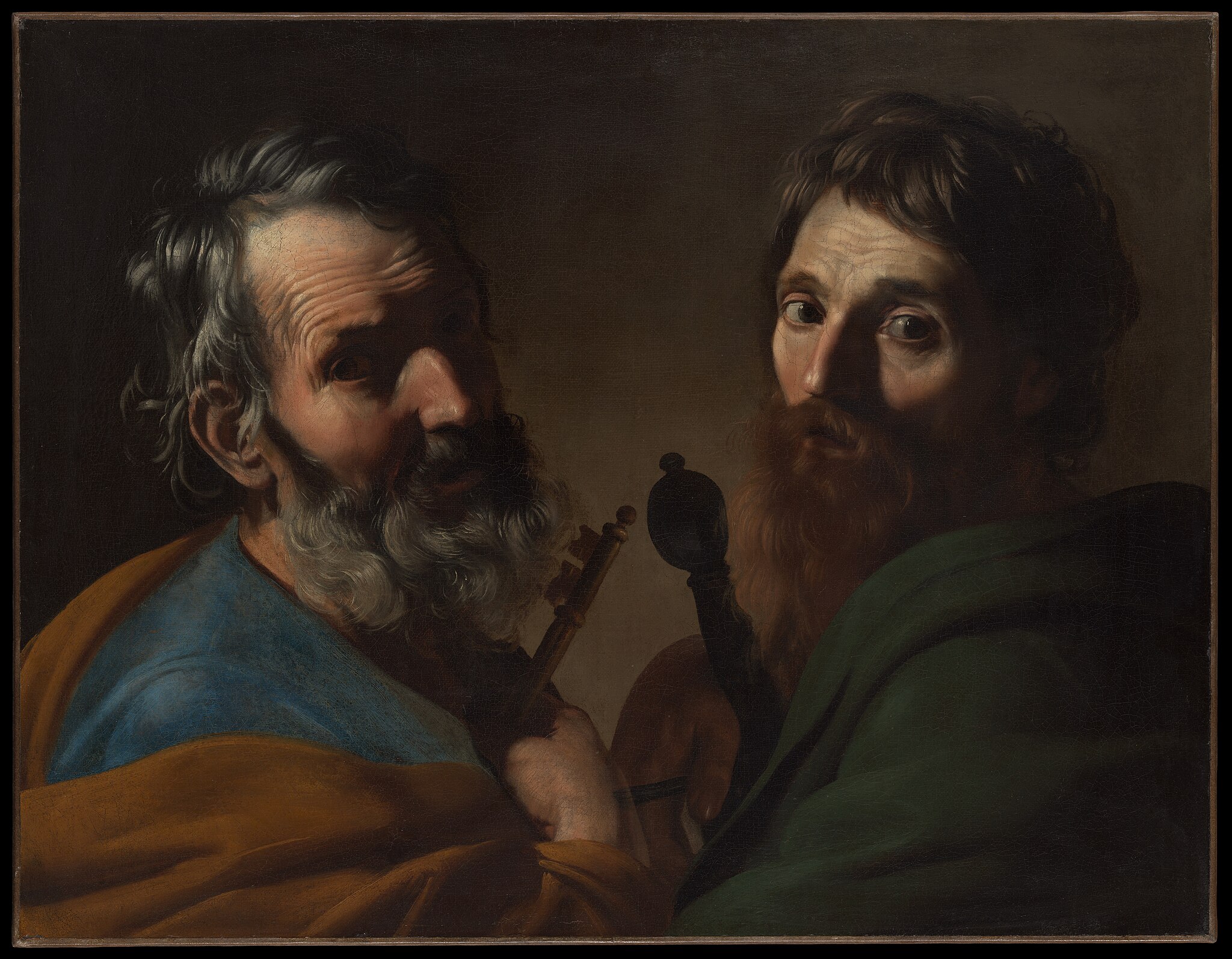
Bartolomeo Manfredi, Saints Peter and Paul (c. 1620)
At birth, Peter was given the name Simon. Simon’s father was John and his brother was Andrew. Simon’s cousins were James and John. Simon and his family grew up in the town of Capernaum on the Sea of Galilee. By trade, they were fishermen. They were also pious Jews, who observed the Sabbath, attended synagogue, and travelled to Jerusalem several times a year for the major Jewish religious feasts. The three pillars of Simon’s life were God, family and work. His world was small and simple, and he liked it that way. As a person, Simon was passionate and emotional, often speaking or acting before thinking. Yet he could also be paralysed by fear. He often found himself desiring competing goods. His most redeeming quality, however, was his humility. Simon learned from criticism rather than rejecting it as a personal attack. His inner life was a complicated mix of virtues and vices, strengths and weaknesses.
At birth, Paul was given the name Saul. Saul was born in Turkey, in the city of Tarsus. His father was a Roman citizen while his mother was a Jew. This meant that Saul grew up in two conflicting cultural worlds – the world of Roman society and the world of Jewish religion. At some point in his youth, Saul found himself having to choose between the two. He turned away from the world of Roman society, moving to Jerusalem and enrolling as a student under the Jewish rabbi Gamaliel. In contrast to Simon Peter, Saul was driven and disciplined. Yet he was also proud and stubborn. He was an all or nothing sort of man, who dedicated himself to persecuting Jewish heretics. Beneath his heroic rejection of Rome in favour of his religion lurked self-love. Like Simon, Saul’s inner life was a complicated mix of virtues and vices, strengths and weaknesses.
A decisive shift occurred in the lives of Simon and Saul when they encounter Jesus. Simon was first introduced to Jesus by his brother, Andrew, when they were visiting Jerusalem for the Jewish religious feast of Passover. Once they returned home, Simon met Jesus again as he was cleaning his fishing nets. In contrast with Simon, who had the humility to accept his brother’s invitation to meet Jesus, Saul needed direct intervention. Saul was commissioned by none other than the Jewish High Priest to purge the dispersed Jewish communities of heretics, especially Christians. Travelling by horse, Saul’s first stop was the Syrian capital, Damascus. As Saul travelled to Damascus, he was overcome by a bright light that left him blind and caused him to fall from his horse. Jesus appeared and spoke: “Saul, Saul, why are you persecuting me?” Simon and Saul first encountered Jesus through the ordinary circumstances of their lives. Jesus entered Simon’s life through faith, family and work. Jesus entered Saul’s life through a journey.
When Jesus encountered Simon and Saul, he presented them with an invitation, a choice. To Simon, Jesus said: “Come, follow me.” To Saul, Jesus said: “Rise and enter Damascus, and you will be told what to do.” Now the ball is in their court. Jesus has entered their life: will they let him in? The Gospels tell us that Simon, upon receiving his invitation from Jesus, “left everything and followed him.” The Acts of the Apostles tell us that Saul, upon receiving his invitation from Jesus, “arose from the ground” and allowed himself to be “led… by they hand and brought… into Damascus” where he “was baptised”. Simon and Saul do not simply meet Jesus. They receive Jesus and commit to Jesus. Moreover, they do not expect Jesus to change for them. Rather, they change their lives for Jesus. To signify the new life and identity that begins with their commitment to Jesus, each receives a new name from Jesus: Simon becomes Peter and Saul becomes Paul. Through their encounter with Jesus and commitment to Jesus, Peter and Paul become new men.
Once Peter and Paul commit to following Jesus, Jesus gives them a mission. Peter is appointed the first Pope and entrusted with the ministry of teaching, sanctifying and governing the Church: “You are Peter, and on this rock I will build my Church.” Paul is sent to preach the Gospel to the Gentile world. As he writes to Timothy: “The Lord stood by me ad gave me power, so that through me the whole Gospel might be proclaimed for all the pagans to hear.” Each in their own way, Peter and Paul help others to meet and commit to Jesus. They share with others what they have first received: Jesus himself.
In fidelity to their distinctive missions, Peter and Paul each made their way to Rome, the political and cultural capital of the world. There, both were arrested and executed around the year 64AD. As a non-Roman Jew, Peter was executed by crucifixion like Jesus. Yet Peter felt unworthy to die like the Lord, so he asked to be crucified upside-down. As a Roman citizen, Paul was given the ‘privilege’ of being beheaded instead of crucified.
Ultimately, Peter and Paul laid down their very lives for Jesus. By laying down their lives for the Lord, Peter and Paul revealed their hearts: they loved Jesus. Only love can motivate someone to lay down their life for another. As Jesus explained at the Last Supper: “No greater love has anyone than this: that he lay down his life for his friends.” Peter and Paul made their very life itself a gift of love to Jesus.
Like Peter and Paul, we are born in a particular place at a particular time with a particular personality. These circumstances are not accidents. They are the door upon which Jesus knocks. Peter met Jesus during a family visit to the city. Paul met Jesus during a work trip. Jesus uses the circumstances of life to get our attention.
Jesus gets our attention so he can invite us to follow him. He wants to share His transforming and life-giving grace with us. He wants to transform us as he transformed Simon into Peter and Saul into Paul. But first he needs our commitment. Committing to Jesus takes courage because it involves change.
Jesus gives a mission to all who commit to him. All who have discovered Jesus are sent to bring Jesus to others. For some, the mission is grand and obvious. For others, the mission is simple and hidden. Either way, Jesus gives us a mission that is chosen for us and suited to us. Through our particular mission, we carry Jesus into the hearts and lives of others, just as Peter and Paul carried Jesus to Rome.
By committing to Jesus and going on mission with Jesus, we give our life to Jesus as a gift of love. In return, Saint Paul tells us, Jesus gives us the crown of righteousness, eternal life: “My life is already being powered away as a libation, and the time has come for me to be gone. I have fought the good fight to the end; I have run the race to the finish; I have kept the faith; all there is to come now is the crown of righteousness reserved for me, which the Lord, the righteous judge, will give to me… The Lord… will bring me safely to his heavenly kingdom. To him be glory for ever and ever. Amen.”
Saints Peter and Paul, pray for us.