
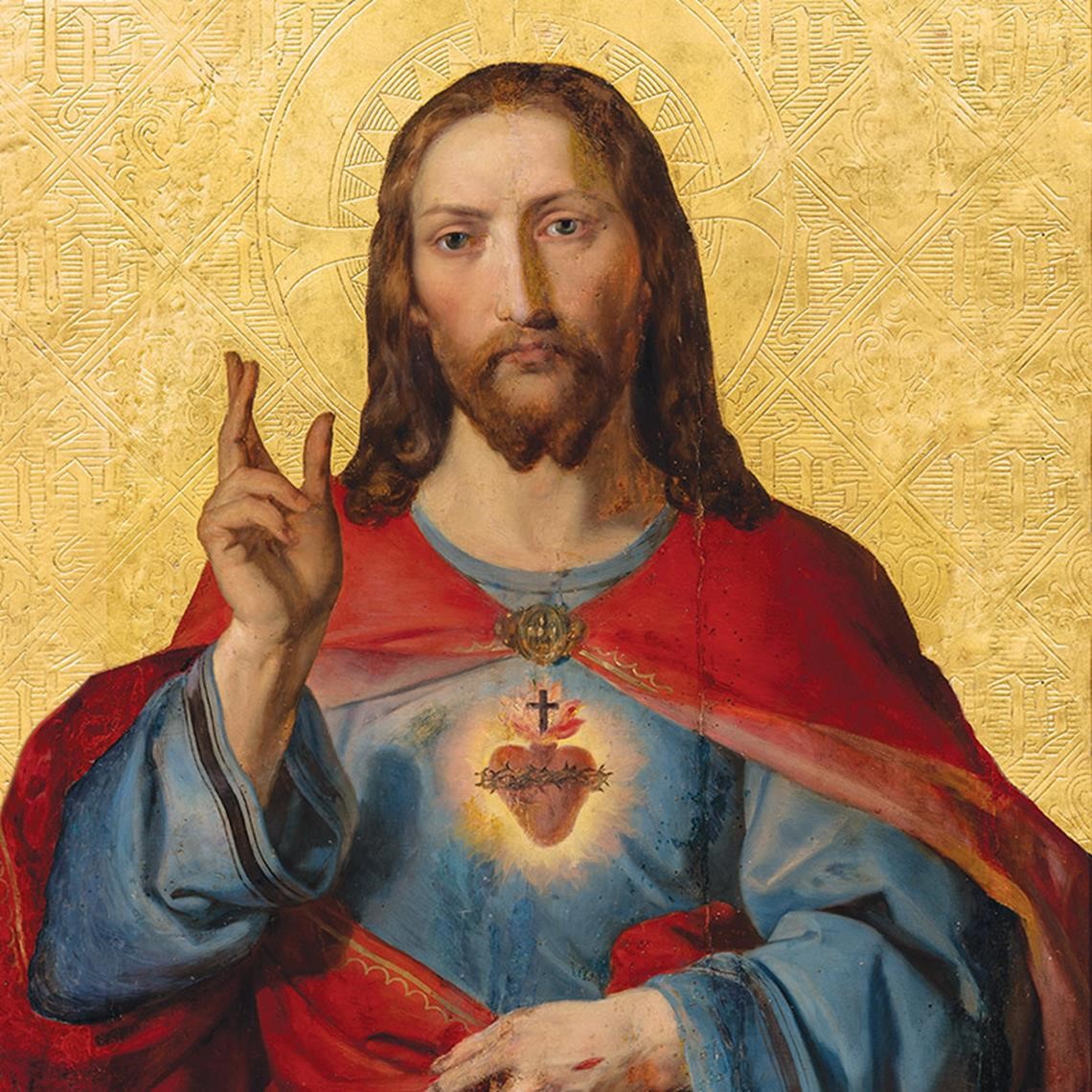
In the Old Testament, there is only one person who can give commandments, and that is God. Sure, the Ten Commandments were given through Moses, but they were not given by Moses: they were given by God. When Jesus gives a new commandment at the Last Supper, He is acting as God.
Jesus describes His commandment as new: “I give you a new commandment: love one another; just as I have loved you, you also must love one another.” At first, this commandment doesn’t sound new: it sounds familiar. In the book of Leviticus, God commands the people of Israel: “You shall love your neighbour as yourself,” (Lev 19:18). When the scribes asked Jesus to summarise the Ten Commandments, He said that this verse from Leviticus summarises the second tablet of the Ten Commandments. The command, “Love one another,” then, is old and familiar. The new part of Jesus’ commandment is the way we are to measure our love for one another: “love one another as I have loved you.” Jesus establishes His Sacred Heart as the measure of how we are to love one another.
What we need to understand, then, is how Jesus loves us. Later during the Last Supper, Jesus defines the commonly accepted maximum human expression of love: “Greater love has no one than this, that he lay down his life for his friends.” Yet in his letter to the Romans, Saint Paul says that we were not Jesus’ friends when Jesus died for us: “God shows his love for us in that while we were still sinners and enemies of God, Christ died for us,” (cf. Rom 5:8,10). There is, in fact, a greater love than laying down your life for your friends, and that is laying down your life for your enemies. Jesus himself taught this during the Sermon on the Mount: “You have heard that it was said, ‘You shall love your neighbour and hate your enemy.’ But I say to you, Love your enemies and pray for those who persecute you.” Jesus loves His enemies. He gives love to those who do not give love to Him. In other words, Jesus loves us unconditionally.
To get our heads around what this means, we need an analogy. Think of a husband a wife. If the wife commits adultery, will the husband continue to love her? Maybe after one instance, the husband will find a way to forgive his wife and continue loving her. But what if the wife repeatedly commits adultery, again and again and again? The husband will stop loving her. Which shows – and this is a very hard truth – that the husband’s love for his wife was conditional. His love for his wife was conditional upon his wife’s faithfulness to him. But that is not how Jesus loves us. As Saint Paul wrote to Timothy: “If we are unfaithful, he remains faithful,” (2 Tim 2:13). Jesus loves us even though we are unfaithful to him. This is one reason that Jesus’ Sacred Heart is depicted open and bleeding: Jesus’ Sacred Heart is always open to us.
I know there are some parishioners who find the fact that I talk about sin uncomfortable. But I do not talk about sin because I like sin or because I want you to feel bad about yourselves. I talk about sin because you cannot understand the depth of God’s love for you if you do not understand sin. If we do not take sin seriously, we actually cheapen God’s love and reduce it to conditional love.
How can we show our gratitude for such unconditional love? Certainly, we give our love to God by observing the first three commandments. We worship God and Him alone, especially in the Mass. We love God because He loved us first. In a certain sense, our love for God is always conditional: it is conditioned by His love for us. So loving God alone is not sufficient to demonstrate our gratitude for His unconditional love. To show our love for God, we must also love those who do not love us. God gives us other people precisely so that we can practice unconditional love.
To put it very simply: “love one another as I have loved you” means that we must give love regardless of whether we receive love in return. When I explained this to someone during the week, they were horrified: “But that hurts!” Yes, yes it does. Giving love regardless of whether we receive love in return hurts like Judas’ traitorous kiss, it hurts like Peter’s denial, it hurts like the beating of the High Priest’s police, it hurts like the Roman scourge, it hurts like the Crown of Thorns, it hurts like the nails and the spear, it hurts like the Cross. How can it be that we have not understood this? Jesus does not hide it from us. “If anyone would come after me, let him deny himself and take up his cross and follow me.” Or, as Saint Paul says, “I have been crucified with Christ.” Giving love regardless of whether we receive love in return feels like death, because it is. To die from love: this is the new commandment.
What Jesus shows us, however, is that we begin to live only when we have begun to die from love. Jesus rose from the dead because he died from love. As Saint Paul says to Timothy, “If we have died with him, we shall also live with him.” Dying from love leads to unending life. This is precisely how Saint Therese of Lisieux described her death: “I am not dying, I am entering into life.” This is also the vision given to Saint John. “I, John, saw a new heaven and a new earth; the first heaven and the first earth had disappeared now, and there was no longer any sea.” In the Old Testament, the sea represents death. A world without the sea is a world without death. “I saw the holy city, and the new Jerusalem, coming down from God out of heaven, as beautiful as a bride all dressed for her husband.” The city is the bride of Christ, the Church, the society of those who live because they have died from love. “Then I heard a loud voice call from the throne, ‘You see this city? Here God lives among men. He will make his home among them; they shall be his people, and he will be their God; his name is God-with-them. He will wipe away all tears from their eyes; there will be no more death, and no more mourning or sadness. The world of the past has gone.’” Giving love regardless of whether we receive love in return feels like death, but in fact it is the end of death and the beginning of life.
Such love is inherently attractive: “By this love you have for one another, everyone will know that you are my disciples.” When you give love to people regardless of whether you receive love in return, people meet the Sacred Heart of Jesus. When people see you die out of love for them, they do not see you – they see Jesus. Through your unconditional love, they discover that Jesus loves them unconditionally too. This is why the first Christians gave the Greek name ‘martyr’ to those who died for their faith in Jesus. The Greek word martyr means witness. The way to give witness to Jesus is to die from love.