
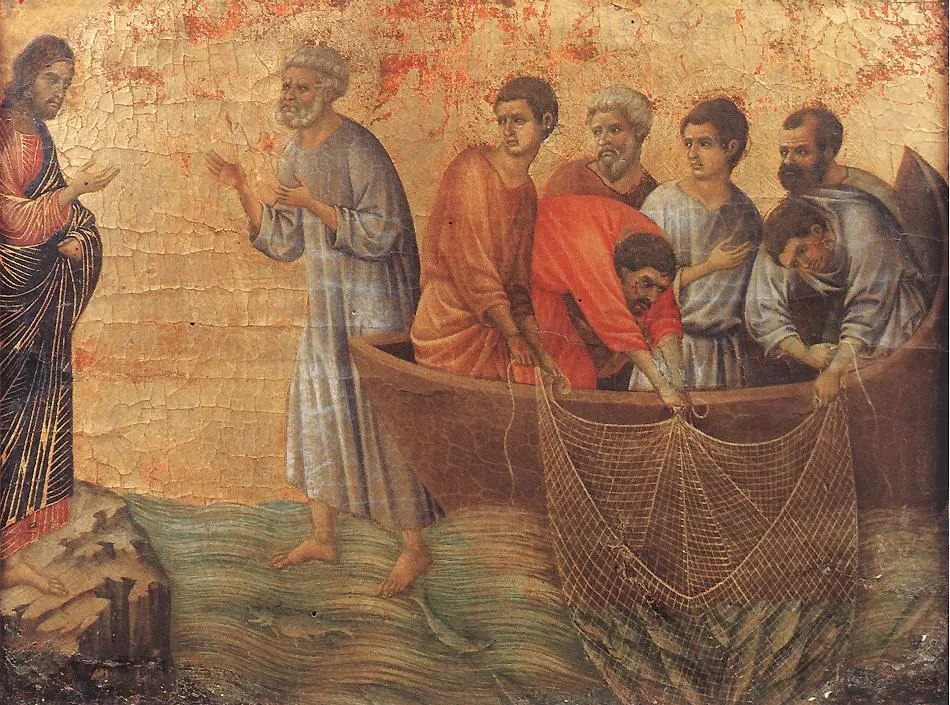
Duccio di Buoninsegna, Appearance on Lake Tiberias (c. 1308-1311)
In the forty days between the Resurrection and the Ascension, Jesus appeared to the apostles on multiple occasions. Each of Jesus’ post-Resurrection appearances have a purpose: founding the means of His continuing presence on earth, His Mystical Body, the Church. When Jesus appeared at the Sea of Galilee, he taught the apostles spiritual truths about the identity and mission of the Church. As He had done on so many occasions before, Jesus made use of familiar material and biblical images to drive home the lesson.
In Sacred Scripture, the sea signifies everlasting death. Think of the great flood in Noah’s day or the waters of the Red Sea that drowned the Egyptians. Within the Sea of Galilee are fish. The fish are alive, but they live in the realm of death. The fish signify humanity, subject to the effects of Original Sin. Boats are sanctuaries of life on the vast expanse of the lifeless sea. Think of Noah’s ark or the basket of reeds into which Moses was placed by his mother. Boats, then, refer to the Church.
Peter’s boat is a particular type of boat. It is not a yacht or a cruise liner – it’s a fishing boat. The Church is like a great fishing trawler that catches people, giving them the life of God by drawing them out of the waters of everlasting death.
Yet it is not the ship itself that catches the fish; the fish are caught by the captain and his crew. At first, Peter appears to be the captain of the ship, surrounded by the other apostles who are his crew. In the same way, it often appears that the ship of the Church is captained by the successor of Peter, the Pope, and crewed by the successors of the apostles, the bishops, who together carry out the work of saving souls. This is not to suggest that the lay faithful cannot cooperate in the work of saving souls; rather, it is a question of emphasis. The clergy bear the chief responsibility for the salvation of souls. The first duty of the lay faithful is to save their own soul with the help of the clergy, and then to cooperate with the clergy in saving others.
With the crew assembled in the boat, Saint John tells us: “They went out… but caught nothing.” Peter and his crew are proficient fisherman. They set out at the right time, with all the requisite human knowledge, skills and resources. Nevertheless, their nets remain empty. The lesson for the apostles and for the Church in every age is this: catching people for God follows a different logic to catching fish. You catch fish by relying on material resources, environmental conditions, and human skill. Yet trying to save souls by relying on human resources and skills alone leads to empty spiritual nets. If the Church today has empty nets, it could be because the crew are operating from the perspective of the horizontal logic of human proficiency. Many today demand the Church change her teachings and practices, then the pews will be full! This is a lie. The Church’s nets are not empty because there has been too little human logic but because there has been too much.
As the apostles lament their empty nets, Jesus appears on the shore: “It was light by now and there stood Jesus on the shore, though the disciples did not realise that it was Jesus.” The shore signifies heaven, the place where Jesus is, the Church’s eternal destination and safe harbour.
From the shores of heaven, Jesus commands the apostles: “Throw the net out to starboard and you’ll find something.” They do as instructed, and they catch so many fish that they could not haul it in. Whereas initially Peter was giving instructions, now Peter is taking instructions from Jesus. Now we can see that Peter is not the captain of the ship after all – Peter is only the first mate. He runs the ship for the captain. Jesus is the captain. It’s his ship. As the first mate, Peter’s job is to listen to and obey the captain. Jesus, not the Pope, is the King of the Church. The Pope’s job is to obey Jesus. Looking towards the conclave, this is the only relevant criterion by which to choose a successor of Peter: does he obey Jesus?
Jesus knows where the fish are. The crew do not. Herein lies the solution to every crisis experienced by the Church. The crew must stop relying on human logic and start listening to Jesus and obeying Jesus. And by crew, I mean the clergy. In the maritime world, if a crew or the officers of a ship rise up against the captain, it is called mutiny. Mutiny is the most serious naval crime, because it destroys the order of the entire enterprise. All the Church’s problems over the last seventy years have their roots in the fact that too many clergy stopped listening to and obeying Jesus. There has been mutiny in the ranks. And I am not convinced that we have yet sufficiently learned our lesson. The nets of the Church only fill when and where we obey Jesus. Jesus knows where the fish are. If we listen Jesus and obey Jesus, our nets will fill.
Yet it is not only the crew who must obey Jesus. It is intriguing that all so many suddenly appear in one convenient location. Presumably Peter and the apostles had tried that spot. So why do the fish turn up just there, just at that moment? Because the fish, too, are listening to Jesus and obeying Jesus. It is not just the clergy who must obey Jesus; each member of the faithful must also cultivate a listening ear and obedient heart.
Peter finds the fish by listening to Jesus, but Peter also listens to the other apostles. It is John, not Peter, who first recognises Jesus: “The disciple Jesus loved said to Peter, ‘It is the Lord.’” By listening to the other apostles, Peter gets a better understanding of Jesus. In the same way, the Pope must listen to his brother bishops, to their concerns and insights. With their help, the Pope deepens his own understanding of what the Lord is asking the Church.
Once the apostles realise that Jesus is on the shore, they race to him as fast as possible. Peter swims for it and the other apostles come in the boat, towing the net full of fish. The point is that the ship’s mission is not just to catch fish, it is to get the fish to shore. In the same way, the Church’s mission is not just to be a worldly society or club, nor a charity or NGO that meets only material needs. The Church draws people in precisely to carry them on to eternal life. Yes, the Church cultivates fellowship and meets material needs, but the Church does these things, as it does all things, in service of the salvation of souls.
As the Church waits trustingly for the election of the next successor of Saint Peter, it is good to be reminded of the Church’s identity and mission. The Church is a great fishing ship crewed by the Pope and the bishops whose mission is to save people from everlasting death and carry them to everlasting life. Yet for both the crew and the fish, one thing is decisive: listening to Jesus and obeying Jesus.