
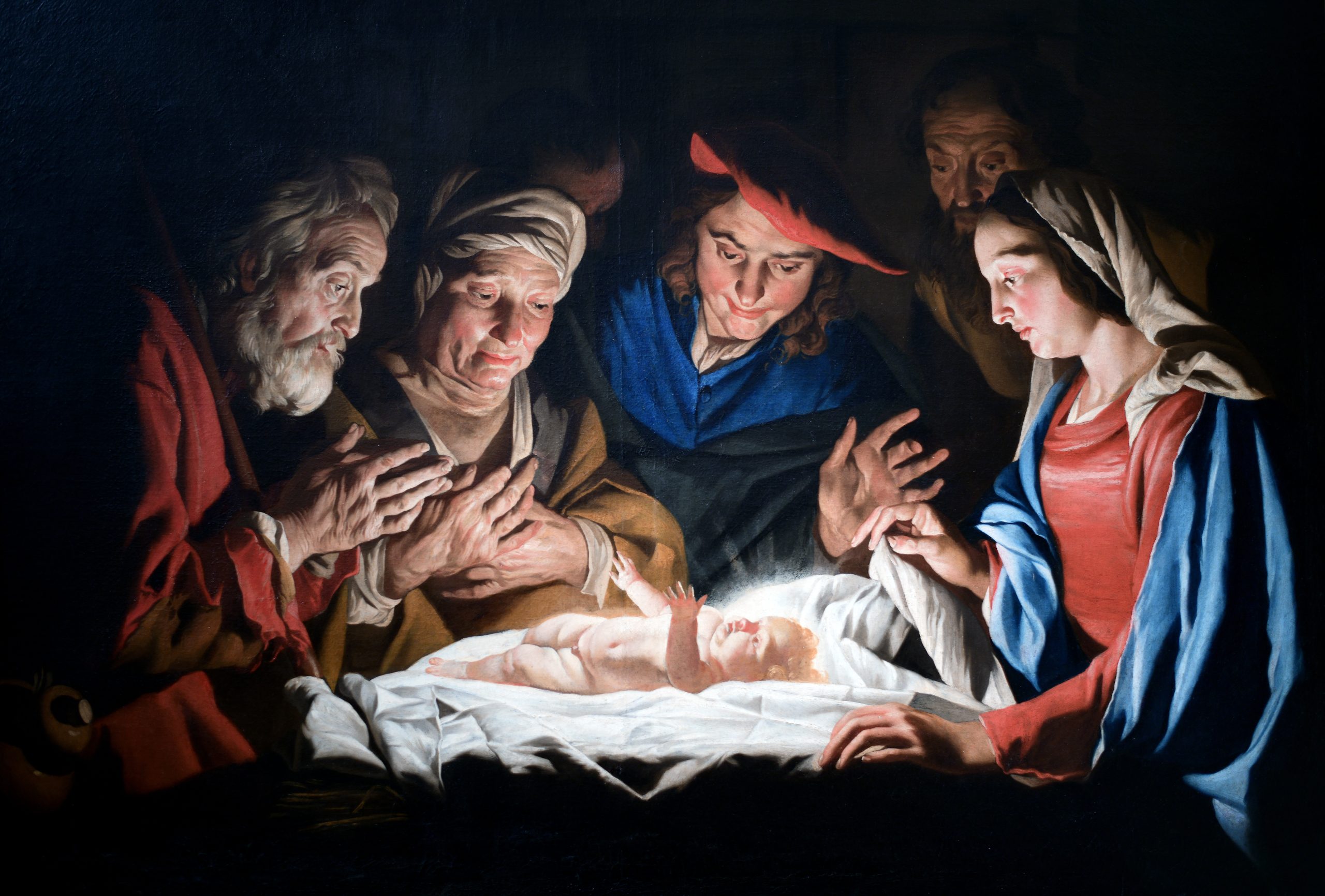
Adoration of the Shepherds by Matthias Stom (c. 1650)
Along with family meals, gift-giving is the Christmas tradition. A few days ago it was reported that Australians will spend, on average, $700 on gifts this Christmas! Even so, the tradition of gift-giving at Christmas reflects the essence of Christmas. Gift-giving is an expression of love. What matters is not so much the material gift, but the gift of self that the material gift expresses. God is also a gift-giver and, at Christmas, He gives us the greatest of gifts. As the prophet Isaiah foretold: “For there is a child born for us, a son given to us.” This gift is the supreme expression of God’s love for us.
Sacred Scripture recounts that God repeatedly uses material realities to express spiritual realities. It is, therefore, no accident that God’s greatest gift to us comes in the form of a baby. In every culture, a new-born baby signifies the gift of new life. Yet this is no ordinary baby. As Gabriel announced to Mary, “The child will be holy and will be called Son of God.” This gift of new physical life contains the gift of new spiritual life, the life of God. The name we give the gift of God’s spiritual life is grace, which comes from the Greek word for gift. As Saint Paul says, “God’s grace has been revealed.”
The prophet Isaiah describes humanity as “the people that walked in darkness… those who live in a land of deep shadow.” Our ready access to electricity means that the symbolism of darkness is often lost on us. Darkness means death, for without light, nothing can live. Light is an essential precondition for life. A people that walks in darkness and the land of deep shadow is a spiritually lifeless people, a spiritually dead people. This is the human condition. Isaiah is describing us.
Yet Isaiah also sees that the people who walked in darkness “have seen a great light,” and that, on those who live in a land of deep shadow, “a light has shone.” This spiritual light shining in our spiritual darkness is “the child born for us, the son given to us.” Just as physical light gives physical life, so, through this child, God offers us spiritual life.
The angel Gabriel is insistent that Mary and Joseph should call this child “Jesus”. The angel explains that the child must be given this name “because he will save his people from their sins.” In Aramaic, Jesus is Yeshua, from which we also derive the English name Joshua. For the Jews, the name Yeshua was heavy with meaning. Yeshua, or Joshua, was Moses’ successor. The first Yeshua, Joshua, led the people of Israel out of the lifeless desert into the new life of the Promised Land. The second Yeshua, Jesus, will lead all humanity out of spiritual death into the Promised Land of Heaven by giving spiritual life.
At the beginning of his public ministry, Jesus explained how he gives spiritual life: “Unless one is born of water and the Spirit, he cannot enter the kingdom of God. That which is born of the flesh is flesh, and that which is born of the Spirit is Spirit.” There are two types of life received through two types of birth: the life of the flesh received by physical birth, and the spiritual life of grace received by the spiritual birth of Baptism. God, the source of all spiritual life, received the life of the flesh by physical birth, so that we who have the life of the flesh by physical birth, might receive spiritual life through Baptism. Or, as Saint Irenaeus put it: “God became man that men might become God.”
Gift-giving is a two-way street. Gifts must be freely given, but they must also be received. Certain gifts, however, must be reciprocated. It would be strange if, at a wedding, the bride simply said, “Thank you,” after the groom had vowed himself to her. Rather, the bride should respond by vowing herself to him.
Through Jesus, God gives us His life. The question God puts to us, then, is: “Will you reciprocate my gift? I give you my life; will you give me yours?” The scene in Bethlehem reveals three possible responses we can make to the gift of spiritual life from Jesus.
The first response is outright rejection. This is the response of Pilate, Herod, and the Jewish priests. Herod tried but failed to kill Jesus at his birth. Pilate and the Jewish priests succeeded where Herod failed.
The second response is indifference. This is the response of the majority of the masses. At Jesus’ birth, most people were simply indifferent. They were asleep. They didn’t want to kill Jesus, but they didn’t want to him to change their lives either.
The third response is to reciprocate the gift. This is the response of Mary, Joseph, the shepherds and the wise men. Later, it was the response of the disciples and apostles. They want Jesus and the gift of spiritual life he offers them so much that they are prepared to give their lives to Him. Moreover, they give their lives to Jesus in a specific way: through sacrifice. Mary and Joseph sacrifice their reputation and suffer persecution, the shepherds sacrifice their livelihood, the wise men make a sacrifice by offering Jesus valuable gifts. Through these sacrifices, Mary, Joseph, the shepherds and the wise men gave their lives to the one who had given them the life of God.
Before Mass this evening we celebrated the Office of Readings. There, we heard Pope Leo the Great urge us to honour God’s gift to us by giving ourselves to God:
Christian, remember your dignity, and now that you share in God’s own nature, do not return by sin to your former base condition. Bear in mind who is your head and of whose body you are a member. Do not forget that you have been rescued from the power of darkness and brought into the light of God’s kingdom. Through the sacrament of baptism you have become a temple of the Holy Spirit. Do not drive away so great a guest by evil conduct and become again a slave to the devil, for your liberty was bought by the blood of Christ.
Saint Paul also urges us to give ourselves to God in response to the gift of grace:
What we have to do is to give up everything that does not lead to God, and all our worldly ambitions; we must be self-restrained and live good and religious lives here in this present world.
Most of us have received the life of God from Jesus in Baptism. But the Christian life is not just about receiving God’s gift of spiritual life, it is about reciprocating the gift through sacrifice. The principal sacrifice by which we give ourselves to God is the sacrifice of the Mass. Now, then, through the words and actions of the Mass, let us offer our lives and hearts to the Father in gratitude for the gift of divine life that began with the birth of Jesus at Christmas.