
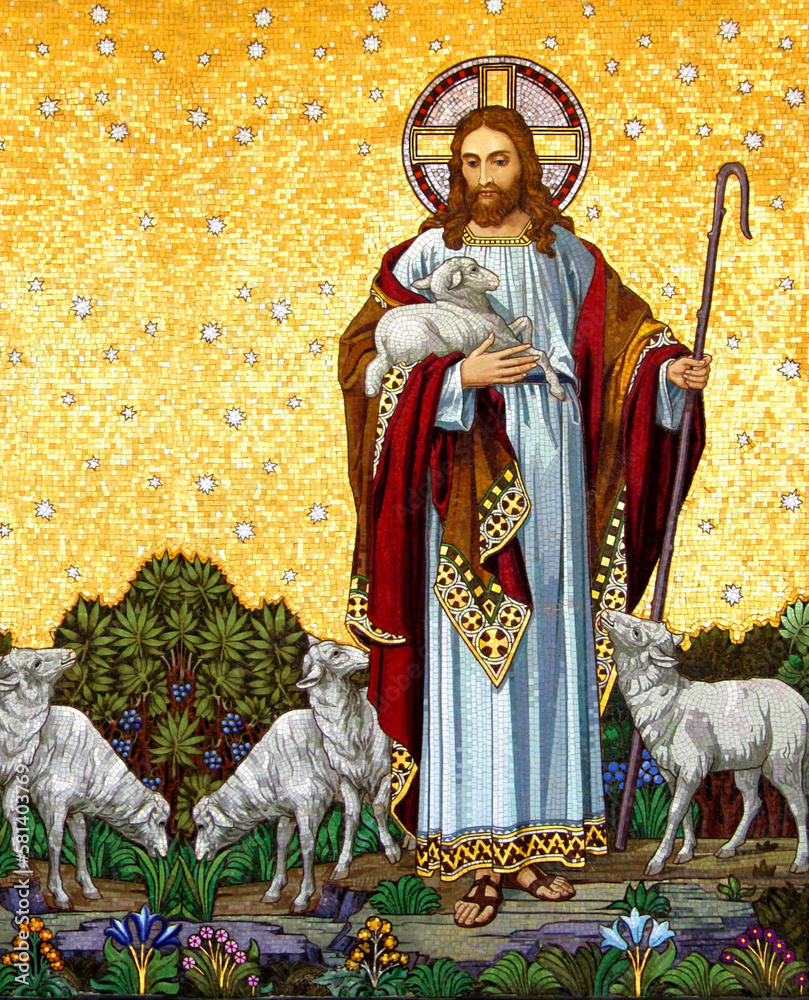
Whenever God needs a leader for his people, his first preference is for a shepherd. Abel, the son of Adam, “was a keeper of sheep,” (Gen 4:2). Likewise, Abraham was “rich in cattle” (Gen 13:2). Isaac, too, “had possessions of flocks and herds” (Gen 26:14). Jacob also shepherded flocks of sheep (Gen 31:4), as did his twelve sons, including Joseph (Gen 37:12-13). The book of Exodus describes Moses as a shepherd: “Moses was keeping the flock of his father-in-law, Jethro, the priest of Midian; and he led his flock” (Ex 3:1). Finally, David describes himself as a shepherd, when he reports to king Saul, volunteering to kill Goliath: “Your servant used to keep sheep for his father; and when there came a lion, or a bear, and took a lamb from the flock, I went after him and struck him and delivered it out of his mouth; and if he arose against me, I caught him by his beard, and struck and killed him,” (1 Sam 17:34-36). God chose so many shepherds to lead his people, that the shepherd became, for the Israelites, an image of leadership.
As the leaders of Israel reflected on God’s preference for shepherds, they came to understand a profound spiritual truth: God was their shepherd, and they were God’s sheep. At the end of his life, Jacob describes God as his shepherd: “The God before whom my fathers Abraham and Isaac walked… has shepherd me all my life long to this day…” (Gen 48:15). Likewise, King David describes himself as a sheep, shepherded by God: “The Lord is my shepherd, I shall not want; he makes me lie down in green pastures. He leads me beside still waters…” (Ps 23:1-2). The image so moved King David that he repeated it in another psalm: “We are his people, the sheep of his flock,” (Psalm 99). As shepherds, the great leaders of the Old Testament were like fathers to their flocks, loving their sheep, guarding and protecting them, feeding them and giving them life. Jacob and David realised that this is exactly how God treated them. God was a shepherd to them, a father of the human flock, who loved them, guarded and protected them, fed them and gave them life. The shepherds were also sheep.
As the centuries passed, however, the shepherds of Israel forgot that they were sheep of God who had to listen to God and follow God. They began to use, rather than serve, their sheep. Consequently, Jerusalem was besieged and captured by the Babylonians, while the people were sent into exile. One of the exiles was the prophet Ezekiel. As Ezekiel adjusted to life in Babylon, he received a message from God. “The word of the Lord came to me: ‘Son of man, prophesy against the shepherds of Israel, prophesy, and say to them, even to the shepherds, ‘Thus says the Lord God: Ho, shepherds of Israel who have been feeding yourselves! Should not shepherds feed the sheep? You eat the fat, you clothe yourselves with the wool, you slaughter the fatlings; but you do not feed the sheep. The weak you have not strengthened, the sick you have not healed, the crippled you have not bound up, the strayed you have not brought back, the lost you have not sought, and with force and harshness you have ruled them… Behold, I am against the shepherds; and I will require me sheep at their hand, and put a stop to their feeding the sheep; no longer shall the shepherds feed themselves. I will rescue my sheep from their mouths,’” (Ezek 34:1-10). The people of Israel were eventually permitted to return to Jerusalem, but they never again had a king to shepherd them.
Instead, God tells Ezekiel that God will come and shepherd his people Himself: “I, myself, will be the shepherd of my sheep, and I will make them lie down… I will seek the lost, and I will bring back the strayed, and I will bind up the crippled, and I will strengthen the weak, and the fat and the strong I will watch over… You are my sheep, the sheep of my pasture, and I am your God,” (Ezek 34:15-16,31). The people of Israel longed God to come and be their shepherd, their Messiah, their anointed king, their Christ.
Three months before Jesus’ death, the Jews ask Jesus if He is the king they have been waiting for: “How long will you keep us in suspense? If you are the Christ, tell us plainly.” Jesus answered them, “I told you, and you do not believe… because you do not belong to my sheep. The sheep that belong to me listen to my voice; I know them and they follow me. I give them eternal life; they will never be lost and no one will ever steal them from me. The Father who gave them to me is greater than anyone, and no one can steal from the Father. The Father and I are one.” Jesus is God the Shepherd, come to shepherd His sheep to the green pastures of eternal life.
The flock given to Jesus by the Father is the Catholic Church. Members of the flock of Jesus are defined by two characteristics: they listen to Jesus and they follow Jesus. We listen to Jesus in Sacred Scripture, in the teachings of the Church, and in prayer. If we do not regularly read scripture, study the teachings of the Church, or pray, we are not listening to Jesus. Likewise, we follow Jesus be observing his law, summarised as love of God and neighbour, and further articulated in the Ten Commandments. If we do not love God and neighbour in the way articulated by the Ten Commandments, we are not following Jesus. As your shepherd, Jesus knows and loves you. Just as shepherds walked with their sheep, Jesus desires to walk with you each day. Listen to him, follow him, and he will lead you to eternal life.
Mindful of our need for visible shepherds, Jesus entrusted His flock to Saint Peter and his successors, the popes. As we heard last Sunday, Jesus entrusted his flock to Peter on one condition: love. “Do you love me more than these others do?” “Yes, Lord, you know I love you.” “Feed my sheep.” Peter’s first duty is to love Jesus. He loves Jesus in the same way we love Jesus: by listening to Jesus and following Jesus.
On Thursday, the College of Cardinals elected the 267th successor of Saint Peter, Cardinal Robert Prevost, who took the name Leo XIV. As he greeted the world from the balcony of Saint Peter’s Basilica, the Holy Father pointed us to Jesus: The Good Shepherd… laid down His life for God’s flock… We are followers of Christ. Christ goes before us. The world needs his light. Humanity needs him as the bridge that can lead us to God and his love.” The enemies of God, led by Satan, reserve their fiercest malice for the shepherd of the flock. “Strike the shepherd and the sheep will be scattered.” We must help our shepherd, who has laid down his life for us. We must pray and sacrifice for him every day.
In 1884, Pope Leo XIV’s predecessor, Leo XIII, experienced a terrifying vision as he finished saying Mass. The vision was of Satan boasting to Jesus that he would destroy the Church, and of demons attempting to carry out the boast, and of Saint Michael the Archangel casting Satan into hell. The vision so moved Leo XIII that he composed the prayer to Saint Michael and ordered that it be prayed after all low Masses. Pope Leo XIV was elected on one of the two traditional feast days of Saint Michael the Archangel, the 8th of May. Therefore, from this weekend on, we will pray the prayer to Saint Michael for Pope Leo XIV after all weekday Masses. Let us also take it up today, entrusting our Holy Father to the protection of Saint Michael, on whose feast he was elected.
Holy Saint Michael the Archangel, defend us in the hour of battle. Be our safeguard against the wickedness and snares of the Devil. May God rebuke him, we humbly pray, and do thou, O Prince of the heavenly hosts, by the power of God, cast into hell Satan, and all the evil spirits, who prowl about the world seeking the ruin of souls. Amen.